In case anybody asks you what Robin’s absolute favorite artistic movement is, it’s Art Nouveau. Quick summary: AN (1890–1915) is characterized by a Japanese influence, the primacy of the line, and a desire to stylize nature. Très aesthetic, and très reactionary against the stiff French art/architecture of the time. Some of my fave AN artists are Alphons Mucha (famous mostly for ads), Tiffany (lamps), Lalique (jewelry), Toulouse-Lautrec (posters, paintings), and Hector Guimard.
Who is this Guimard, you ponder. He was a Parisian architect responsible for the crazy Métro entrances of 1900 for which Paris is famous. He’s somewhat underappreciated for his work beyond the édicules. He designed a lot of buildings in the 16th arrondissement, some of which were later destroyed by people who just didn’t get it. This week, I had a free two hours and I decided to be adventurous and explore the 16th, hunting Guimard’s AN buildings!
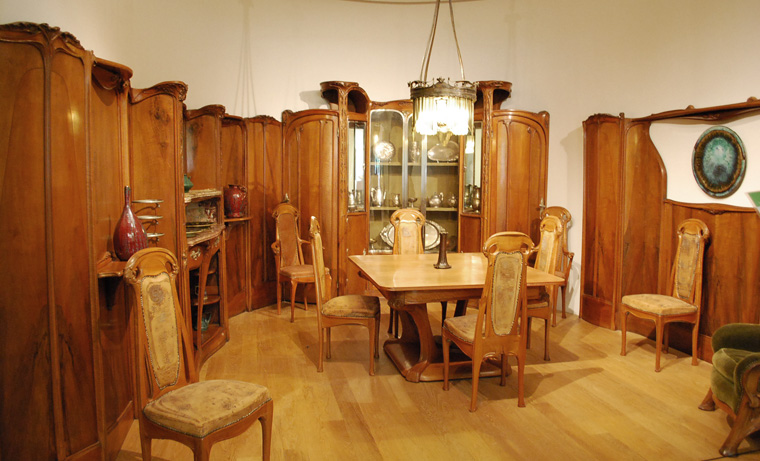
To the left is Hôtel Guimard, the house he designed for himself and his wife. He conceived everything: the iron balconies, the window shapes, the room layout, and, most impressively to me, the furniture inside. All of it.
Below is la salle à manger, the dining room. It’s not actually in Hôtel Guimard anymore — the entire room has been preserved in the Petit Palais, a museum in the middle of Paris.
More after the jump…
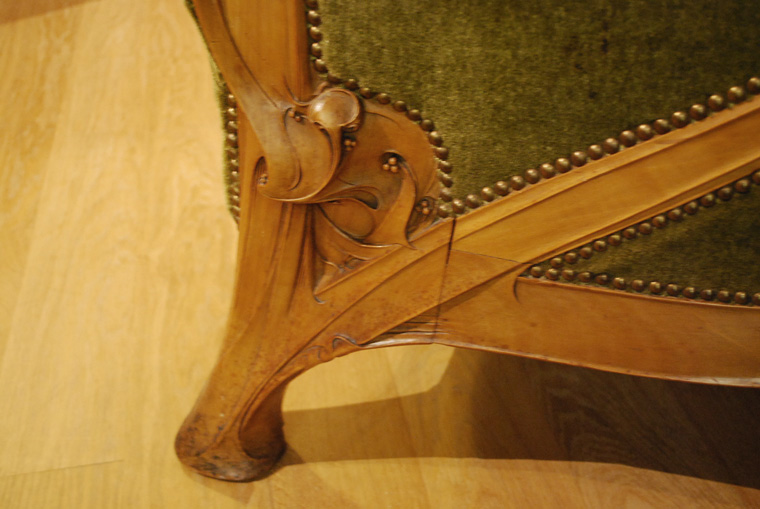
Guimard used pear tree wood for all of this furniture, feeling that it had a warm and luminous color. It was also easy to carve the supple, elegant forms he desired. Below, slightly blurry chair detail:
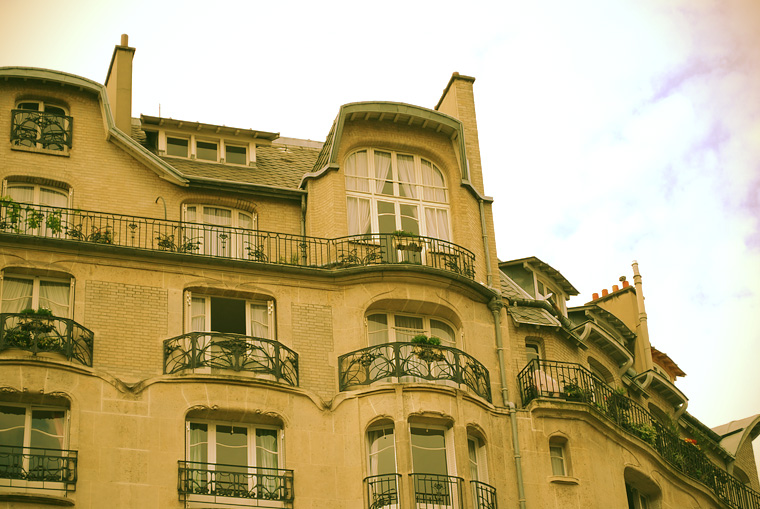
Below: here’s an apartment building on Rue de La Fontaine he designed. Check out those balcons — drool! Can you believe that some lucky jerks get to live here?!
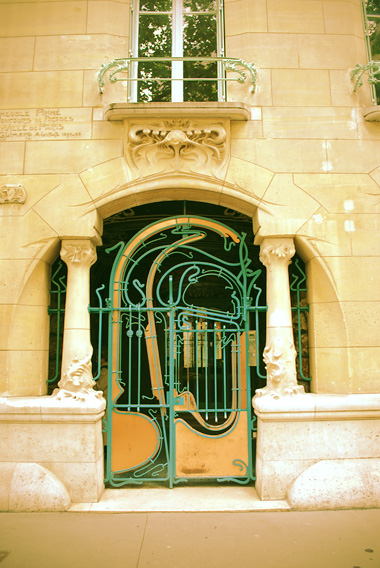
And lastly, to the left is the gate of Castel Beranger, his chef d’œuvre according to some people. I didn’t get many good photos of it, since I discovered too late that I’d been on manual focus the whole time and so everything was a little blurry. And I couldn’t take more photos because these two dudes unloading a truck were watching me curiously (this was just another random beautiful Paris building to them; I looked like a major creepster). So I’ll have to go back sometime.
In any case, is this not the craziest gate you’ve seen? Compared to the other boring style Second Empire entryways of Paris, it’s dynamite. To me, this verges on Art Deco, the movement that followed Art Nouveau.
That concludes today’s Art Nouveau tour. Because it has become an obsession, expect more posts in the future.

I love it!
Are you an architecture student? Thats a rather impressive and interesting blog entry. hats off for that.
I just wanted to know whether you would know about how Paris influenced Hector and his designs when he moved there.
Im doing a bit of research for my presentation which is due in two days and would like to gather a few points about him.
Thank you
Hi Akash,
Thanks for your kind words about my blog post. I’m not studying architecture, but I am a library science student, so I’m happy to help out with your research.
In Paris, Hector Guimard studied at the École Nationale des Beaux-Arts in the atelier of Gustave Raulin. Here, he removed himself from the conformity of the Beaux-Arts and studied Viollet-le-Duc’s fundamental doctrines, including the rejection of historicist academicism [whatever that means]; the preference for the gothic style; and the integration of the spectrum of materials, from the iron to the foundry, traditionally considered lowly — he found that their technical and architectural qualities were part of a modern perspective. He broke with the Société des artistes français, which had admitted him in 1889 and was in control of the Salons.
(This is almost a literal translation of a paragraph in an article entitled “Hector Guimard entre deux siècles” by Claude Frontisi, in the journal Vingtième Siècle. Revue d’histoire, No. 17, Jan-Mar 1988. If you’re a university student, there’s a chance you might have access to the article through EBSCOhost.)
So one answer to your question is that his exposure to new and modern ideas in Paris led him to rebel against the traditions of the École des Beaux-Arts, in a way biting the hand that fed him. The turmoil within the art world at that point produced a lot of interesting and controversial stuff — you might also want to take a look at the Secessionist art movement(s) around the same time.
Hope that helps. Good luck with your presentation.
—Robin
Hi Robin,
I’ve just come across your blog which was really interesting – I spent yesterday wandering around the 16th taking in all the fabulous buildings!
I’m currently doing a university project on Hector Guimard and the (very brief) art nouveau movement in Paris. I was hoping you could help me with a couple of things…
- do you know if it’s possible to see inside any of Guimard’s buildings. I was hoping in particular to see Hotel Mezzara (60 rue la Fontaine)?
- also, can you recommend any sources of information (in English) about Guimard, art nouveau, arts and crafts, the picturesque movement etc? I know the American Library in Paris has some things, but it would be useful to hear your thoughts too!
- Above you mention a really useful sounding article by Frontisi… do you know if there is an English translation of this?
Many thanks for all your help!
Becky
Hi Becky,
Thanks for your comment. I believe most of my knowledge about Guimard came from the internet, an art history class for which I’ve lost the notes, and various books that chronicle Art Nouveau as a movement.
The only Guimard building I’ve ever been in was the Victor Horta house in Brussels, Belgium— which you should definitely see. It’s only a (long) train ride away from Paris! [EDIT 12/1/11 — As Marcin points out below, the Victor Horta house in Brussels was designed by Horta, not Guimard. I am an idiot. Regardless, it is a beautiful example of AN architecture and is a must-see if you're ever near it.]I don’t think there’s a translation of the Frontisi article, but if you’re in Paris, you’re surrounded by French people who can translate for you
The library in the Centre Pompidou has a ton of art monographs, and I think I also went there to research Guimard.
Best of luck! Sorry I can’t provide more sources.
Robin
Dear Robin,
I think we share the same passion but… be carefull.
Hotel Victor Horta is not a building by Guimard but by the architect Victor Horta himself. Horta was the first architect that designed buildings and interiors in the art nouveau style (he designed also interiors, furniture, lighting etc) and represents the art nouveau style in Belgium as Guimard does for France, Gaudi for Spain and Rennie Mackintosh for Scotland. The second important architect was Henry van de Velde, whose style inspired mostly German speaking countries. Paul Hankar, an architect that worked in Brussels and a colleague of Victor Horta, met Guimard in 1894, a year after Horta finished his Hotel Tassel in Brussels. This building is said to be the first edifice build in pure art nouveau style. Horta started allready in 1889 with developing his own style that was called but later on art nouveau. You could say that Horta inspired the architects in France and was the true inventor of this very fashionable style of the Belle Epoque.
Best regards from Belgium,
Marcin
Marcin, you are totally right — I don’t know what I was thinking in August. Of course the Horta house was designed by Horta! I feel more than a little silly and must express my apologies to the late Mr. Horta.
You are lucky that you live in Belgium and can see such beautiful buildings by celebrated Belgian designers. Can’t say I’m getting my art nouveau fix here in central Illinois.
Best,
Robin